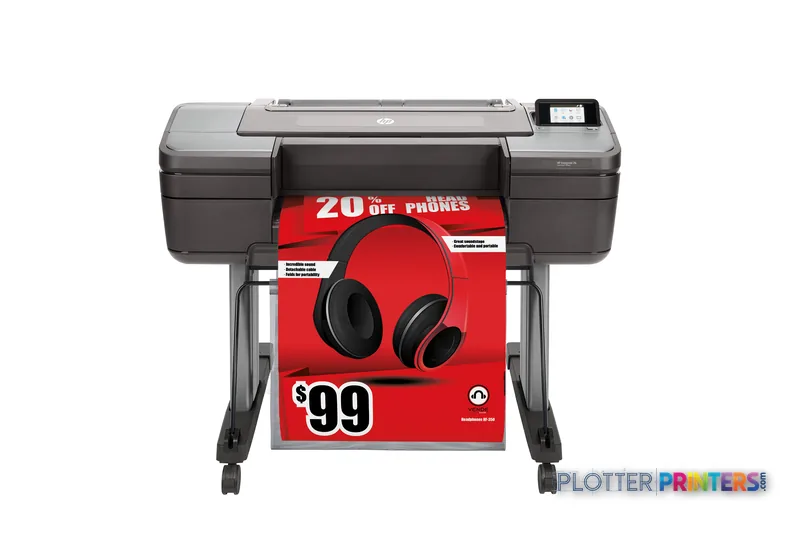
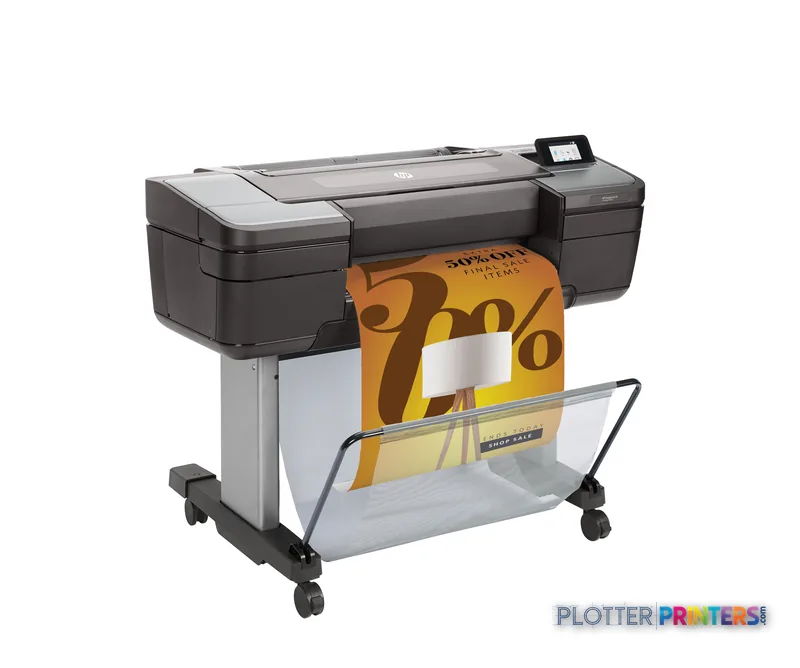
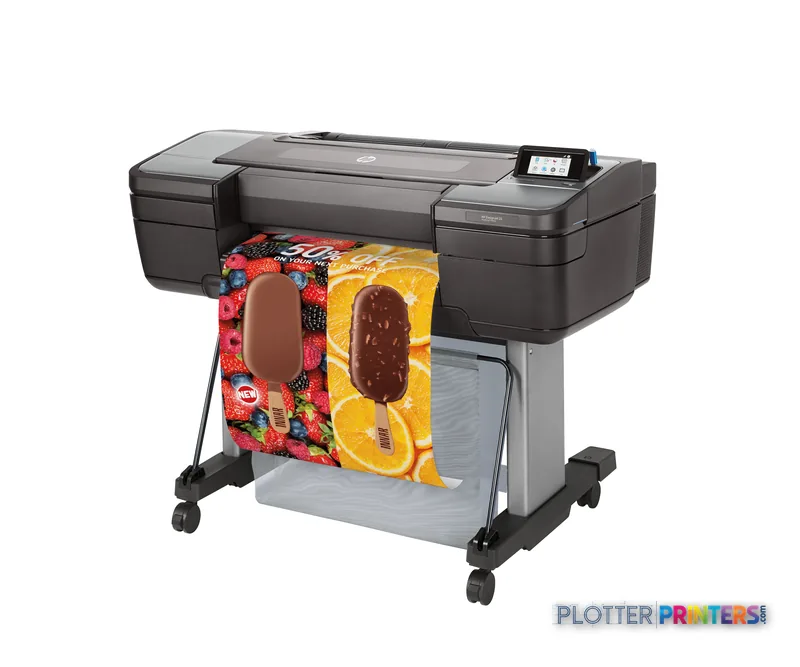
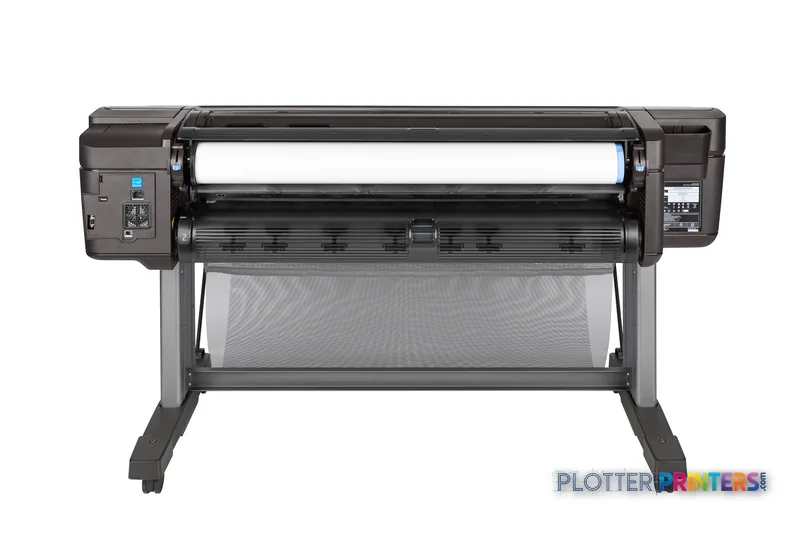
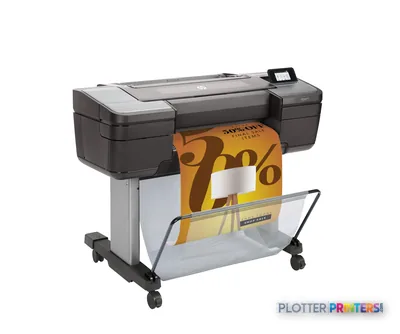
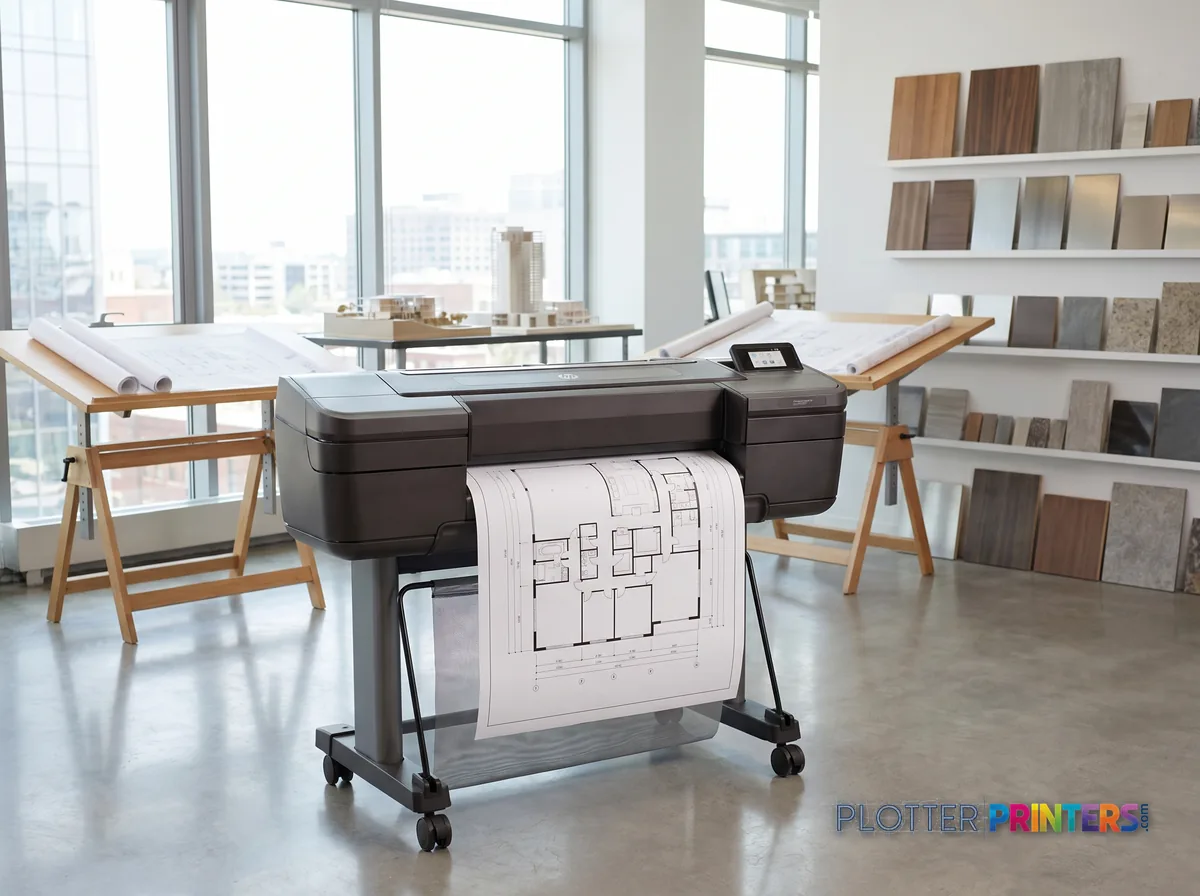
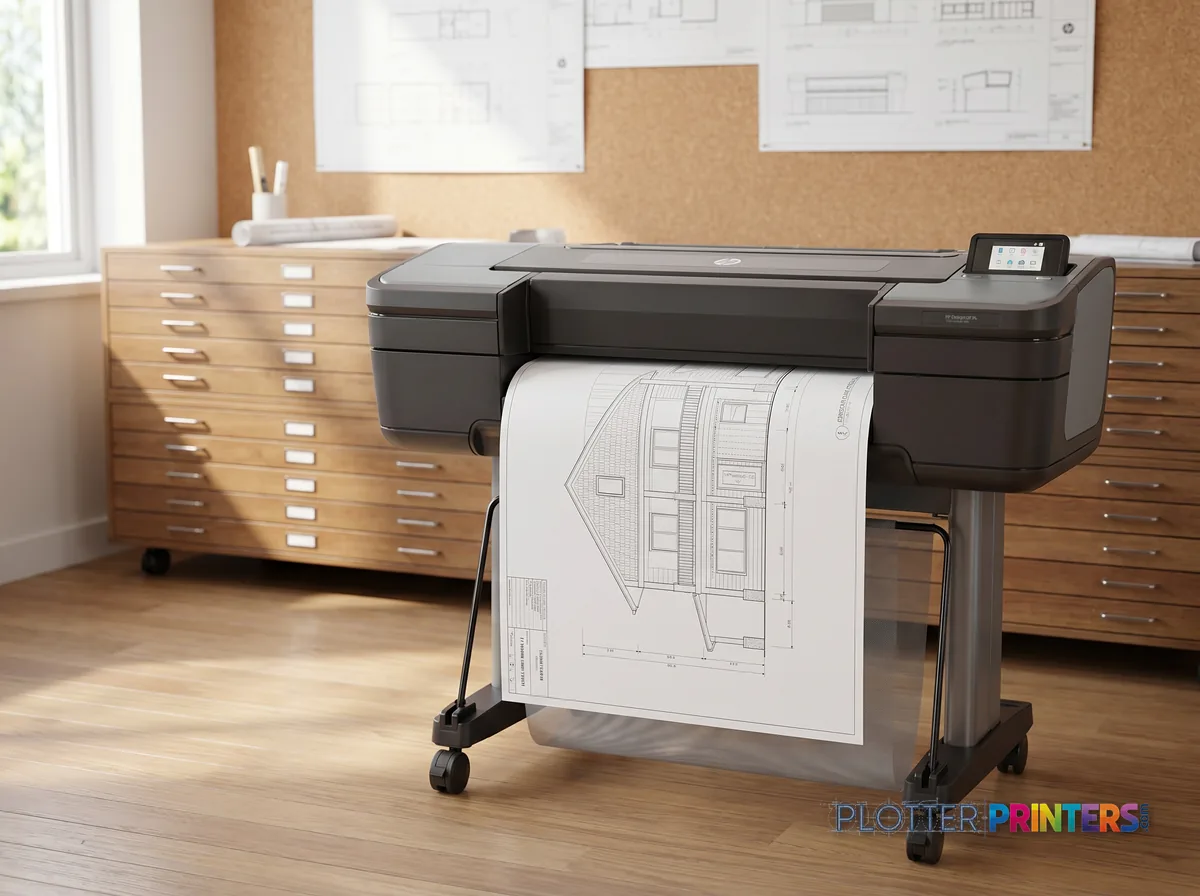
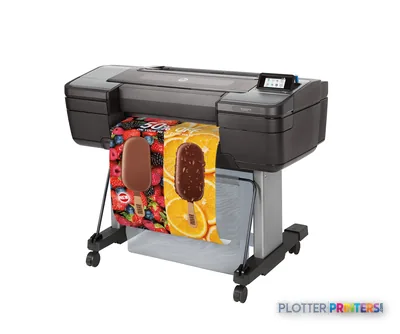
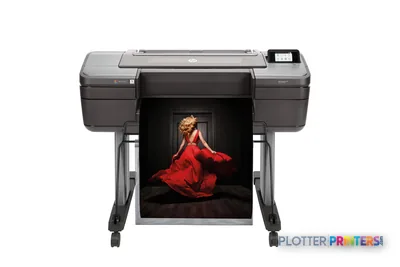
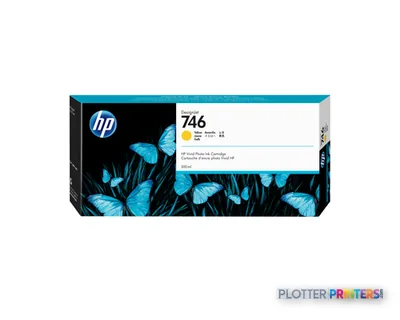
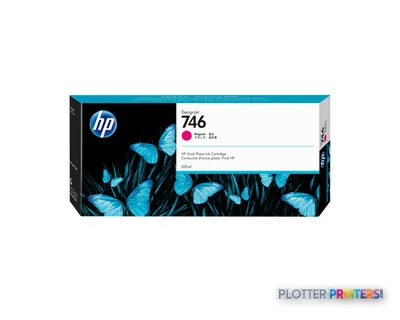
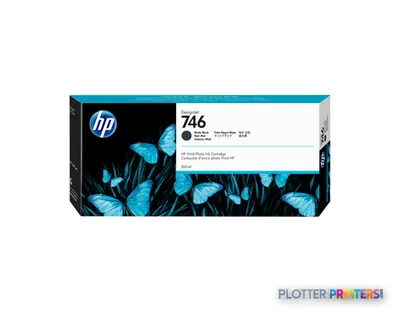
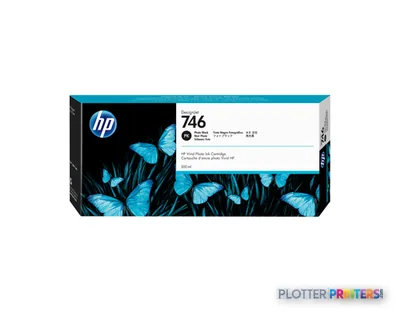
The DesignJet Z6 24-in is a single-roll pigment-ink plotter built for the point where technical accuracy meets presentation color. Where a dye-based technical plotter is happy laying down crisp black lines, the Z6 uses a six-ink set — cyan, magenta, yellow, photo black, matte black, plus a chromatic optimizer — through three printheads to hold color that stays put. That matters where color lives: the last five percent of a saturated red on a rendering, the graded blues of a GIS floodplain map, a site plan taped to a fence for a month. HP rates it at up to 66.9 m²/hr in normal quality and prints at up to 2400 x 1200 dpi.
Presentation-grade renderings and board work that must survive daylight and handling
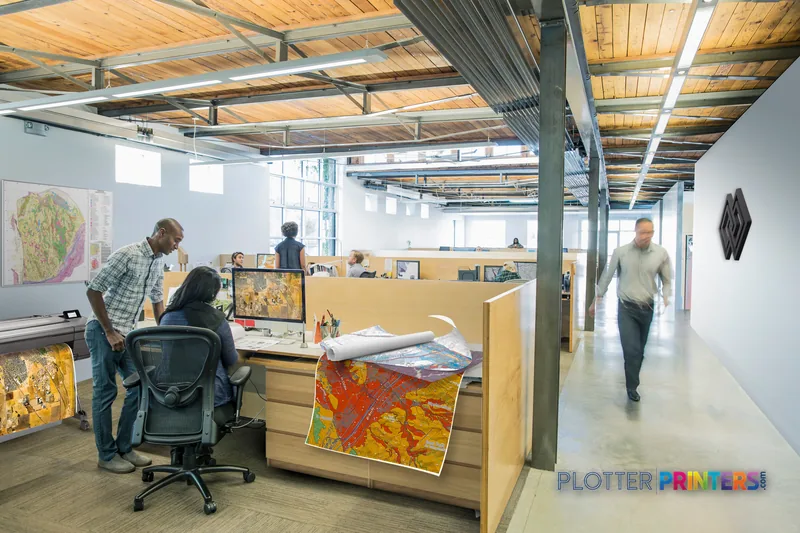
Color-coded coordination sets, GIS and survey maps where hue separation carries meaning
Outdoor-durable site plans — HP cites the industry’s highest WIR print-permanence ratings
Mixed workflows via PostScript 3, PDF 1.7 and HP-GL/2, so CAD and design files share one queue
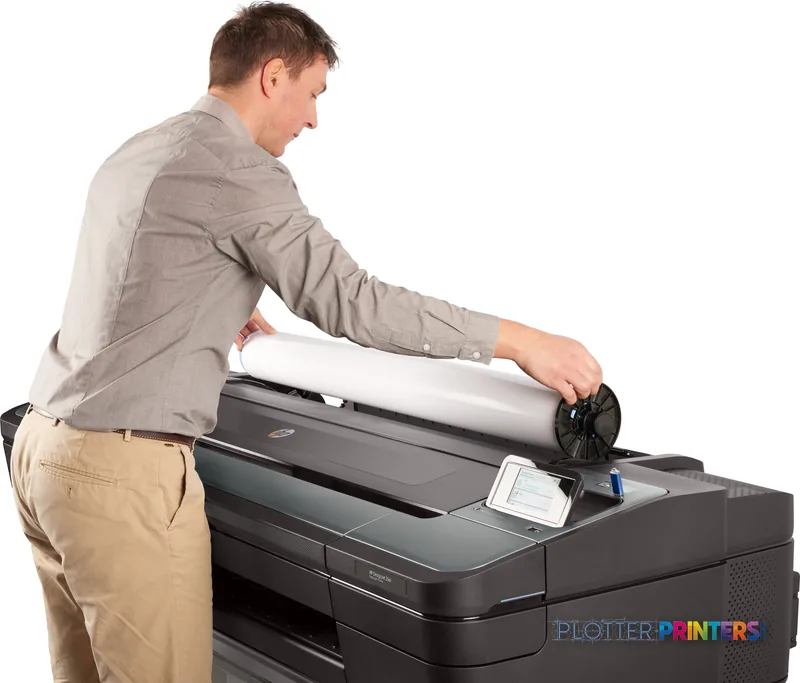
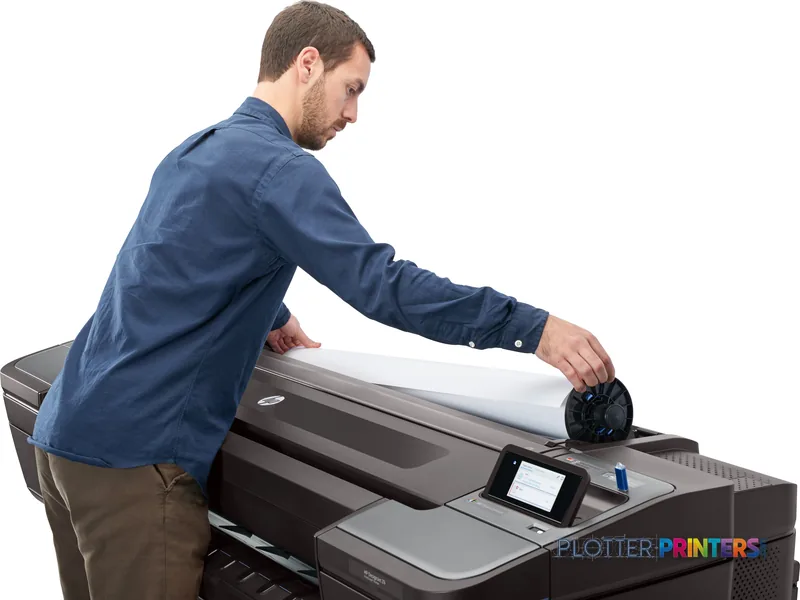
Takes rolls up to 24″ wide
It is less the right tool for pure high-volume monochrome blueprinting; a dedicated technical plotter runs faster and cheaper per print, and some users note default line color can read light in AutoCAD. If you need dual rolls or 44-inch width for renders, look up the family to the HP DesignJet Z9+ 24-in or the HP DesignJet Z3200ps 44-in.
PostScript 3, PDF 1.7, HP-GL/2, TIFF, JPEG, HP-RTL, CALS G4
Connectivity
Gigabit Ethernet, Wi-Fi Direct, USB Type-A, HP ePrint
Media handling
Roll 11–24 in, cut sheets, up to 0.031 in thick; internal HDD, 4 GB memory
Ideal for: firms producing color renderings, coordination sets, GIS and survey maps that must reproduce accurate, durable color. Not the tool for: high-volume black-and-white bid and permit sets, where a faster, lower-running-cost technical plotter earns its keep.
A 24-inch pigment inkjet built for color fidelity, not high-volume monochrome plotting.
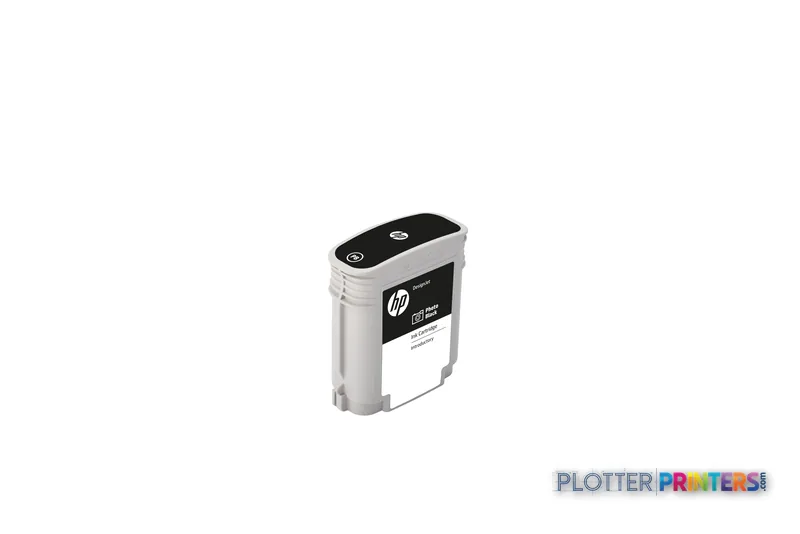
Six cartridges and dual black inks (photo and matte) serve photographic and matte media.
On-board PostScript 3 and PDF 1.7 processing rasterize complex rendered files on the printer.
HP rates it at 66.9 m²/hr in normal quality — a ceiling, not sustained office throughput.
Single 24-inch roll only; no scanning or copying built in.
Now a transitioning model with a launched successor, but still serviceable for years.
The first thing you notice on a well-tuned Z6 isn’t a line weight or a plot speed — it’s a saturated site-plan red that still looks like a red at arm’s length, and a photographic aerial that holds its shadow detail instead of collapsing into mud. That’s the argument this 24-inch machine makes: it is a pigment-ink graphics printer that happens to speak fluent CAD, rather than a technical plotter that dabbles in color.
For AEC teams whose deliverables have crept from black-line prints toward rendered elevations, GIS overlays and presentation boards, that distinction matters. The HP DesignJet Z6 24-in PostScript model sits at the point where drawing production and image quality overlap — and understanding that overlap is the whole decision.
2400 x 1200 DPIMax resolution
66.9 m²/hrRated print speedHP's normal-quality figure — treat as a ceiling, not sustained throughput
Cyan, Photo black, Matte black, Magenta, YellowInk setpigment inks across six cartridges, three printheads
24" (61 cm)Max roll width
What it actually is
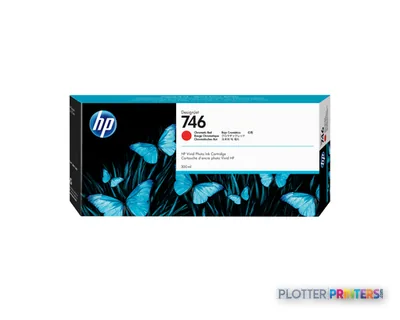
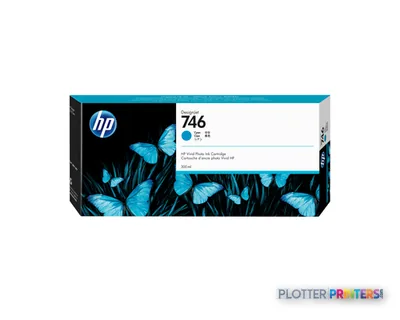
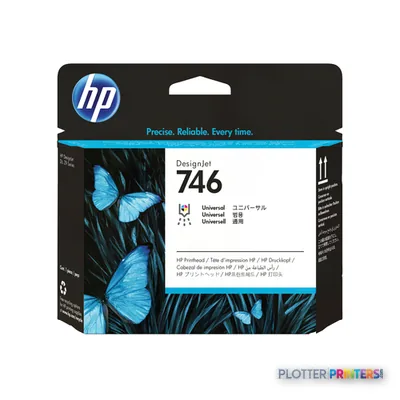
This is a single-roll, 24-inch pigment inkjet built on the HP 746 ink family and HP 746 printhead. Six cartridges feed five colors — cyan, magenta, yellow, and both photo black and matte black — which is the real tell: dual blacks exist to serve photographic and matte media, not just to darken text. The PostScript designation matters for print-room life, because PDF 1.7 and PostScript 3 processing on board, alongside HP-GL/2 and 4 GB of memory, means complex rendered PDFs rasterize on the printer rather than choking a workstation.
On the media we’d put it on — plain bond and HP coated stock — the measured color story is the honest reason to buy it. The eye reads it in the last five percent of a deep, saturated blue on a coordination drawing, the place where cheaper dye plotters go flat. See our measured-gamut hub for how we characterize that on identical paper rather than quoting a 2-D marketing percentage.
sRGB coverage (by volume)59.9%
Adobe RGB coverage (by volume)50.4%
Measured on the same coated stock we run every wide-format printer through — so the difference you see is media-neutral, not a spec-sheet flourish. All measured printers →
Where it fits, and where it doesn't
The Z6 earns its place where color credibility is the deliverable: rendered elevations, GIS and civil overlays, and site plans that need to survive outdoors. HP cites the highest print-permanence ratings in the industry for this class of pigment output — a claim worth attributing, but the underlying pigment chemistry is genuinely why these prints hold up better than dye equivalents.
Studios producing presentation-grade renders alongside working drawings
Civil and survey teams printing color-coded GIS and coordination maps
Any office needing PostScript/PDF fidelity from Revu, Revit or InDesign
Firms wanting outdoor-durable pigment site plans from one 24-inch unit
It is less the right tool for high-volume monochrome bid and permit sets. Independent AEC users note that AutoCAD line colors can print “light” at default settings, and a technical T-series machine is faster and cheaper per black-line plot. If color simply isn’t your product, step down within the family to something like the HP DesignJet Z2100 24-in. If you want a deeper, more consistent color engine in the same 24-inch footprint, the HP DesignJet Z9+ 24-in is the step up — you can line them up side by side before deciding.
Where the Z6's rated throughput lands against its 24-inch class — remember roll changes, drying and mixed-size jobs pull real-world numbers below any rated figure. See the full class ranking →
Estimate plot times for your own run lengths.
One set: – · Weekly plotting time: –
Computed from the manufacturer's rated 916 ft²/h. Real-world mixed sets run slower — treat this as a best case for comparing machines, not a promise.
Lifecycle and support
One practical note: as of mid-2026 HP has introduced a successor Plus Edition of the Z6, so this model is now transitioning and often sells at clearance. It is not end-of-service — HP typically keeps Z-series parts and ink flowing for several years past catalog retirement, which points to serviceability into roughly the early 2030s. For a buyer chasing a favorable acquisition on proven hardware, that’s an opportunity; for a ten-year fleet-standardization plan, ask your dealer directly about parts and HP 746 ink supply timelines. See how this unit ranks against peers on our 24-inch class board.
The single 24-inch spindle and integrated media bin — compact enough for a studio corner, but plan for one roll at a time.
The read
Buy the Z6 for what your eye already told you in the first paragraph: pigment color that reproduces a saturated render or a durable site plan with fidelity a technical plotter won’t match. It is a color-first machine that handles CAD competently, not a monochrome production workhorse. If your week is mostly black-line permit sets, look at a lighter-color or technical sibling; if color fidelity and depth are the point and you want more headroom, weigh the Z9+. On the media we measured, the Z6 does the thing it’s built for convincingly — just size the purchase to the transitioning lifecycle and confirm your local service coverage before you sign.
Graded on a curve against the best published spec among the wide-format printers we track — 100 = the catalog’s gold standard for that metric (the finest droplet, the longest warranty, the fastest rated speed actually on the market). Every input is a manufacturer-published spec; rated speeds are shown as listed, not timed throughput. Ticks mark the class best. How we grade →
Category leaders best color graphics & photo printers, by dimension
Measured on Hahnemühle Photo Gloss Baryta 320 — the same paper we put every printer on, so the only thing that varies is the printer and its ink. Computed with ArgyllCMS from the paper maker’s ICC profile: real measured color data, not a spec-sheet claim.
704KCIELAB gamut volume — within the sRGB working space
59.9%of sRGB by volume
50.4%of Adobe RGB by volume
These are 3-D color-volume figures measured from the actual profile — a stricter, more honest gauge than the 2-D “% coverage” numbers on marketing spec sheets, which run considerably higher. Use them to compare printers on the same basis.
Media
Volume (Lab³)
sRGB
Adobe RGB
Photo Gloss Baryta (common basis)
703,926
59.9%
50.4%
Backlit film
766,825
58.8%
51%
Vinyl
711,297
60.9%
50%
Satin / semi-gloss photo
707,601
60.3%
49.8%
Premium glossy photo
707,601
60.3%
49.8%
Glossy photo
632,099
57.6%
46.6%
Fine-art
449,685
44.2%
34.2%
Matte photo
449,685
44.2%
34.2%
Plain / coated
449,685
44.2%
34.2%
Canvas
407,370
40.8%
31.1%
Other media
174,386
19.4%
13.3%
Gamut volume is the size of the reproducible color solid in CIELAB, computed with ArgyllCMS iccgamut. Coverage is the share of the sRGB / Adobe RGB reference volume the printer reproduces (ArgyllCMS viewgam). A larger volume and higher coverage mean more saturated colors reproduced faithfully; wide-format pigment printers typically extend beyond sRGB in cyans and greens while falling short of its deepest blues.
Gigabit Ethernet (1000Base-T); USB 3.1 gen 1 and rear USB 2.0
Control panel
15.6-in (396-mm) touchscreen to preview and enhance images
Internal storage
500 GB
manufacturer-verified = checked against the manufacturer’s official datasheet, not aggregator data. Everything else is standards-body / catalog data we consider reliable.
Specifications
Full technical detail
Print technologyInkjet
Max resolution2400 x 1200 DPI
Max print width24"
ColorColor
ConnectivityEthernet (Gigabit LAN), USB
Use casePhoto / Fine Art
Printing
Color
Yes
Print head
3
Printing colors
Cyan, Photo black, Matte black, Magenta, Yellow
Print technology
Inkjet
Resolution color
2400 x 1200 DPI
Maximum resolution
2400 x 1200 DPI
Number of print cartridges
6
Page description languages
PostScript 3, PDF 1.7, HP-GL/2, TIFF, JPEG, HP-RTL, CALS G4
Print speed (normal quality)
66.9 m²/hr
Performance
Display
LED
HP segment
Business
Certification
Compliant with Class A requirements, including: USA (FCC rules), Canada (ICES), EU (EMC Directive), Australia (ACMA), New Zealand (RSM), China (CCC), Japan (VCCI), Korea (KCC), South Africa (SABS)
Product color
Gray
Storage media
HDD
Internal memory
4096 MB
Built-in display
Yes
Country of origin
China, Thailand
Paper handling
Cut sheets
Yes
Media thickness
0.8 mm
Custom media sizes
210 x 279 to 610 x 1676 mm
Maximum print size
A1 (594 x 841 mm)
Maximum roll width
24" (61 cm)
Media width (sheets)
610 mm
Maximum roll diameter
5.31" (13.5 cm)
Roll widths supported
279 – 610mm
Paper tray media types
Coated paper, Bond paper, Photo paper, Banner
ISO A-series sizes (A0…A9)
A1, A2, A3, A4
Ports & interfaces
USB port
Yes
Ethernet LAN
Yes
Wi-Fi Direct
Yes
USB connector
USB Type-A
Direct printing
Yes
RJ-45 ports quantity
1
Ethernet LAN data rates
10,100,1000 Mbit/s
Mobile printing technologies
HP ePrint
Technical details
Box contents
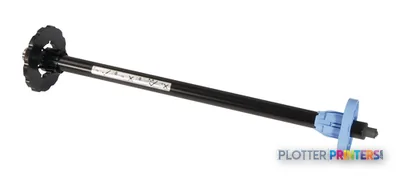
HP DesignJet Z6 PostScript Printer, printheads, introductory ink cartridges, printer stand and media bin, spindle, quick reference guide, setup poster, power cord
Weight & dimensions
Depth
27.4" (695 mm)
Width
50.9" (1293 mm)
Height
39.3" (998 mm)
Weight
145.5 lbs (66 kg)
Power
AC input voltage
100 – 240 V
AC input frequency
50/60 Hz
Power consumption (off)
0.1 W
Power consumption (sleep)
6.5 W
Power consumption (typical)
100 W
Operational conditions
Storage temperature (T-T)
-25 – 55 °C
Operating temperature (T-T)
5 – 40 °C
Operating relative humidity (H-H)
20 – 80%
Other features
Safety
EU (LVD and EN 60950-1 compliant); Russia, Belarus, Kazakhstan (EAC)
UNSPSC-code
43212104
Electromagnetic compatibility
Compliant with Class A requirements, including: USA (FCC rules), Canada (ICES), EU (EMC Directive), Australia (ACMA), New Zealand (RSM), China (CCC), Japan (VCCI), Korea (KCC), South Africa (SABS)
Copying
Copying
No
Scanning
Scanning
No
Logistics data
Harmonized System (HS) code
84433210
Packaging data
Package depth
30.2" (766 mm)
Package width
56.7" (1440 mm)
Package height
28.3" (718 mm)
Package weight
213.8 lbs (97 kg)
Bundled software
HP Click printing software, HP PrintOS, HP Web Jetadmin, HP DesignJet Utility including HP Color Center, HP Partner Link, HP JetAdvantage Security Manager (optional), HP SmartStream (optional)
Drivers included
Yes
Quick start guide
Yes
Cartridge(s) included
Yes
Sustainability
Sustainability compliance
Yes
Sustainability certificates
ENERGY STAR
Sustainable technologies and materials
30% post-consumer recycled plastic; Free, convenient HP ink cartridge and printhead recycling with HP Planet Partners; Highest WIR Print Permanence Ratings in the Industry; ENERGY STAR certified; EPEAT registered
Carbon footprint
Total carbon footprint (kg of CO2e)
820
Carbon emissions, logistics (kg of CO2e)
52
Carbon emissions, end-of-life (kg of CO2e)
1
Carbon emissions, manufacturing (kg of CO2e)
755
Total carbon emissions, w/o use phase (kg of CO2e)
Is the Z6 a good choice for high-volume black-and-white bid sets?
Not primarily. Independent AEC users report AutoCAD line colors can look light at default settings, and a technical T-series plotter is faster and cheaper per monochrome plot. The Z6 makes sense when color renders and durable site plans are the deliverable.
Why does it have two black inks?
It carries both photo black and matte black. Dual blacks let it hold deep neutral density on photographic media and matte stock alike — a photographic-quality feature rather than a text-darkening one.
Does it scan or copy?
No. Scanning and copying are not built in. If you need wide-format capture, HP pairs it with external units such as the HP SD Pro 44-in Scanner or HP HD Pro 42-in Scanner.
What inks and printhead does it use?
It uses the HP 746 pigment ink family across six cartridges and the HP 746 printhead, with three printheads total. Pigment chemistry is the reason its prints resist fading better than dye equivalents.
How many rolls and what widths can it handle?
One roll at a time, from 11 up to 24 inches wide, on a maximum 5.31-inch roll diameter, plus cut sheets. There is no automatic dual-roll switching, so plan media changes into unattended runs.
Is it still current, and will it be supported?
HP launched a successor Plus Edition in June 2026, so this model is transitioning and often discounted. It is not end-of-service; HP typically supports Z-series parts and ink for several years past retirement, but confirm timelines with your dealer.