Expert analysis
What you should know
Key takeaways
- The Canon iPF785 36-in is a five-color, 36-inch inkjet plotter for AEC drawings, maps, and color-coded technical documents.
- Canon rates plain-paper A0 output from 0:41 in Fast Economy Mode to 1:15 in Standard Mode.
- Roll and cut-sheet support suit varied office plotting, but the 20-sheet output capacity favors attended production rather than long unattended sets.
- Its 320 GB internal storage, Ethernet LAN, USB connectivity, and supported network protocols make IT deployment and governance part of the buying decision.
- The Canon iPF770 36-in is the more relevant in-family choice when scanning and copying are routine, while the Canon iPF815 44-in addresses a true wider-media requirement.
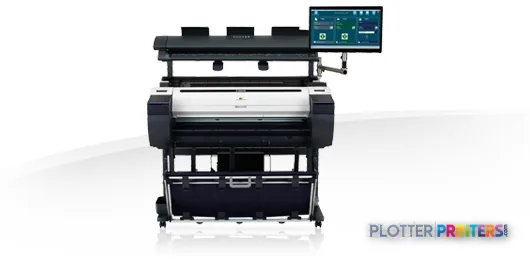
AEC plotting is rarely held up by the act of printing alone. It is the PDF that arrives late, the wrong roll that is loaded, the sheet set that needs a reprint, and the operator who has to decide whether a fast draft is good enough for a coordination meeting. The Canon iPF785 36-in is a color inkjet plotter for that everyday 36-inch plan-production lane: CAD drawings, PDFs, maps, color-marked coordination sheets, and presentation-oriented technical output up to A0.
Its useful proposition is straightforward: a compact-footprint machine with roll and cut-sheet support, onboard storage, Ethernet and USB connectivity, and a 36-inch media path. Canon rates an A0 plain-paper print at 0:41 in Fast Economy Mode, 0:48 in Fast Mode, and 1:15 in Standard Mode. Those ratings are a sensible starting point, not a promise that a mixed PDF set will emerge at the same interval. File processing, roll changes, trimming, and collection still own part of the clock.
A0 (33" x 47" (841 x 1189 mm))Maximum print size
2400 x 1200 DPIMaximum resolution
8"–36" (203.2 – 914 mm)Roll media width
320 GBInternal storage capacity
Where it earns its place in an AEC workflow
The Canon iPF785 36-in fits architecture, engineering, surveying, and construction teams that need dependable access to D-size and 36-inch roll output without moving every plot through a central reprographics operation. The five-color set—black, cyan, magenta, matte black, and yellow—supports the practical mix of monochrome linework and color-coded drawings that turns up in permit sets, utility plans, phasing diagrams, and GIS work.
The 3 mm roll and cut-sheet margins, borderless-printing support across specified standard widths, and cut-sheet capability matter when work moves between ordinary plan sets and occasional presentation or review sheets. Its 20-sheet output capacity is adequate for attended short runs; it is not evidence of a fully unattended finishing workflow. Money is minutes, and an operator sorting mixed-size output is still part of the production system.
For organizations comparing adjacent Canon choices, Canon iPF780 36-in is the natural same-width step-down conversation, while Canon iPF770 36-in deserves attention where scanning and copying are integral to the drawing-room routine. The right comparison begins with workflow, not a spec-sheet relay race.
Production speed needs operational context
Canon’s plain-paper A0 ratings make this machine most compelling for recurring plan output where a fast first plot and reasonable sustained rhythm are more important than sophisticated finishing. On coated paper, Canon rates A0/roll output at 1:15 in Fast Mode, 2:24 in Standard Mode, and 3:50 in High Quality Mode. That trade-off is normal: presentation-oriented output asks for more time than a bid-room line drawing.
The practical limitation is not print quality; it is production handling. One roll path, a 20-sheet output capacity, and manual human decisions around media and set assembly make the iPF785 a better fit for distributed workgroups than for a central department feeding many simultaneous project teams. If 44-inch media is a genuine requirement, Canon iPF815 44-in is the relevant in-family direction. If the requirement is simply 36-inch CAD output, avoid buying width you will not use.
IT, media, and service questions that should not be deferred
For IT, this is a networked device rather than a standalone plotter: it includes Ethernet LAN, USB Type-A, a 320 GB internal drive, and support for TCP/IP (IPv4/IPv6), SNMP with Canon MIB support, HTTP, IPX/SPX, and AppleTalk®. That gives administrators familiar network-management hooks, but it also means the device belongs in the organization’s printer inventory, access review, and replacement planning. A plotter that saves thirty seconds a plot buys you nothing if the file spends four minutes finding it.
Confirm driver deployment, PDF workflow behavior, monitoring expectations, and support ownership before installation. Also verify that the proposed media fits the published 8- to 36-inch roll range, the 10- to 36-inch sheet range, and the stated thickness range. Consumable planning should include the Canon 6704B001, Canon 6705B001, Canon 6706B001, Canon 6707B001, Canon 6708B001 inks and the Canon MC-10 maintenance item. Local service coverage and parts response can alter the ownership experience more than a modest paper specification ever will.
For a cross-brand, same-class comparison, use the Canon iPF785 36-in and Epson SC-T5100 36-in comparison tool and put the same files, media, and support assumptions on both sides of the table.
The read
Choose the Canon iPF785 36-in if your office needs color and monochrome AEC output up to 36 inches, has attended short-to-medium plan runs, and values Ethernet-connected production with roll and cut-sheet flexibility. Choose the Canon iPF770 36-in if scan-and-copy work is a regular part of the process; choose the Canon iPF815 44-in if wider media is a real requirement. For large, continuously collated sets, buy the machine for the workflow you have, not the one the brochure imagines.